

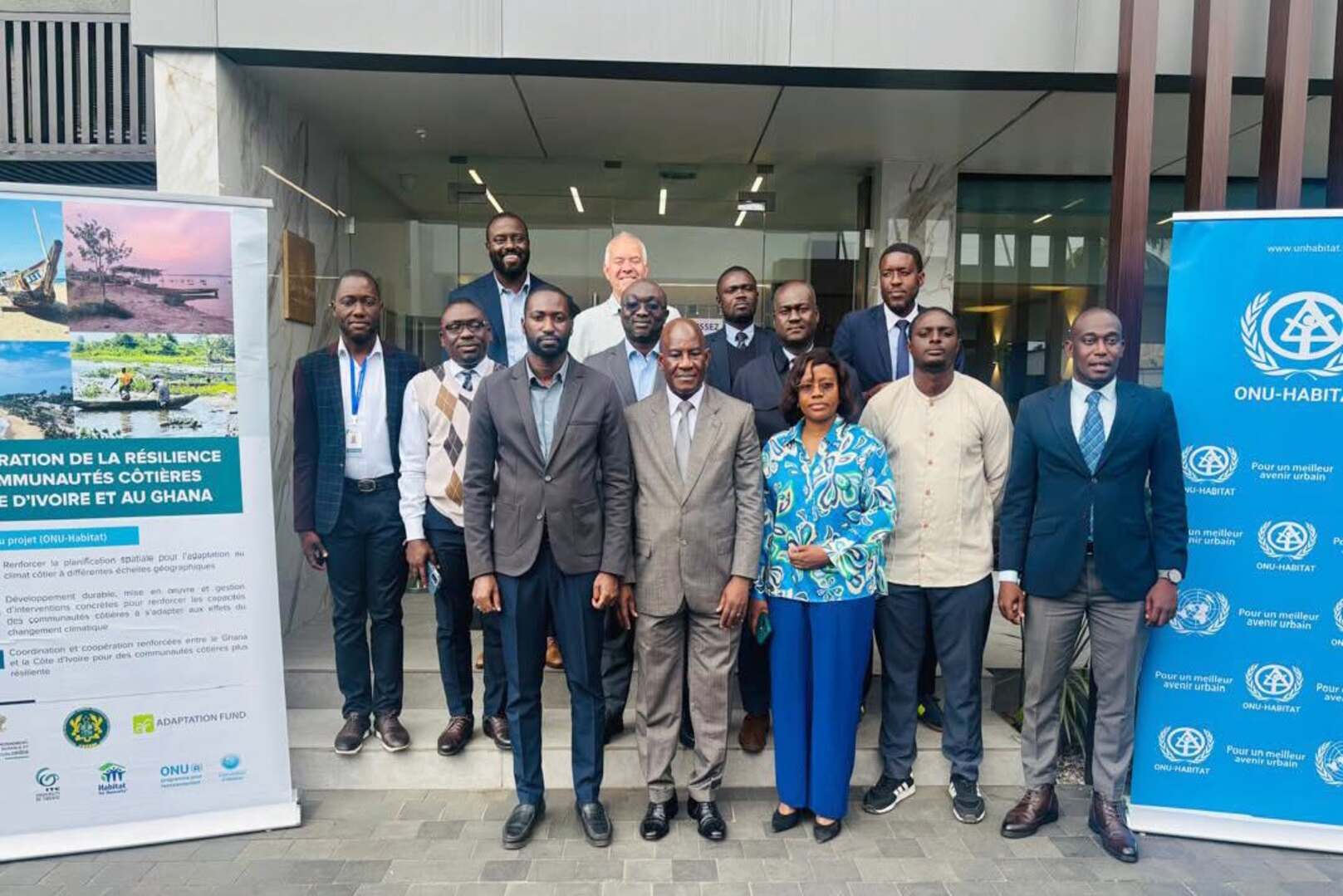
Abidjan, September 18, 2026 – The Ministry of Environment and Ecological Transition reaffirmed on Thursday, September 17, 2026, in Abidjan-Cocody, its commitment to coastal protection and community resilience against climate change. The announcement was made during the third Steering Committee session of the project titled "Improving the Resilience of Coastal Communities in Côte d'Ivoire and Ghana."
Organized with support from UN-Habitat and the Adaptation Fund, this meeting evaluated the project's progress and defined directives for the upcoming semester. Key stakeholders involved in strengthening coastal community resilience in Côte d'Ivoire attended the event. For additional updates on national environmental initiatives, visit In Côte d'Ivoire.
Representing the ministry, Professor Georges Kouadio, technical advisor and chairman of the project's Steering Committee, emphasized the urgency of delivering sustainable solutions to climate change impacts, which severely affect coastal populations. "Residents of coastal cities are particularly exposed to coastal erosion, worsened by climate change effects, especially rising sea levels," he noted, calling for concerted action among the government, technical and financial partners, and local communities.
For the ministry, mangrove restoration serves as a critical lever for coastal protection. These ecosystems help mitigate population exposure to erosion and sea encroachment. Consequently, the project plans to raise community awareness regarding practices that degrade mangroves while directly involving local residents in restoration efforts. Income-generating activities are also planned to offer sustainable economic alternatives.
Furthermore, the ministry is paying special attention to youth training and integration. Regional agricultural training centers are planned in Côte d'Ivoire and Ghana, leveraging technological innovations and artificial intelligence applied to agriculture.
Participants stressed the need to account for local realities, including land tenure issues, the involvement of traditional chieftaincies, and youth participation. Coordination with territorial administration also remains essential to ensure coherent interventions.
Another prospective avenue discussed was leveraging carbon credits generated from mangrove restoration and tree planting an approach capable of preserving ecosystems while generating additional income for local communities.
UN-Habitat Project Coordinator Mouhamadou Diène commended the leadership of the Ministry of Environment and Ecological Transition in project implementation, as well as contributions from partners, including the University of Twente, represented by Luc Boerboom.
Following an initial phase of institutional structuring and activity launches, the Steering Committee's work now aims to identify performance gaps relative to initial planning and accelerate field-level results. Read more Côte d'Ivoire news on our platform.