

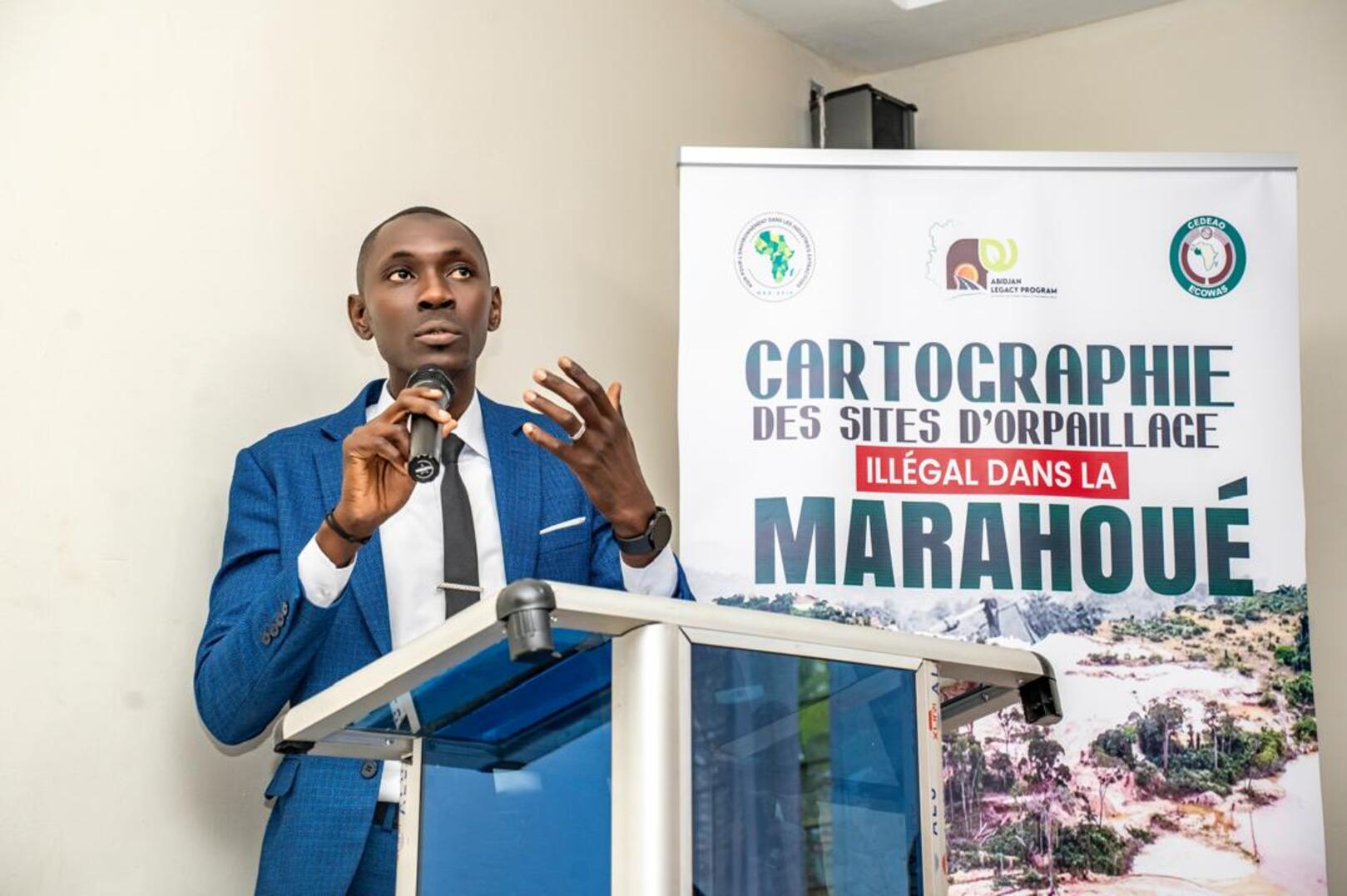
Abidjan Legacy Program and Action for the Environment in Extractive Industries officially launched an initiative to combat illegal gold mining and rehabilitate degraded land in Côte d'Ivoire on Thursday, May 21, 2026, in Bouaflé. The ceremony also marked the start of a mapping study of illegal mining sites in the Marahoué region.
Organized as a workshop, the event brought together administrative authorities, local stakeholders, civil society organizations, and technical partners around a common objective: the sustainable restoration of ecosystems affected by the uncontrolled exploitation of natural resources.
Representing the ALP coordinator, Elvis Kouacou Yao, a specialist in Water and Forests, Climate, and Environment, highlighted the scale of the issue, noting that more than 1,600 illegal gold mining sites have been identified across the country.
In response to this situation, ALP aims to rehabilitate 4,500 hectares of degraded land by 2030 through the mapping of affected areas, reforestation, agroforestry, and support for communities in developing sustainable economic activities.
He emphasized the need for collective mobilization involving local authorities, community leaders, private-sector partners, media, and local populations. “The restoration of ecosystems is not the responsibility of one institution alone. It is everyone’s responsibility,” he declared.
The program is financially supported by Economic Community of West African States (ECOWAS) and benefits from the technical expertise of AEIE, which was praised for its ability to produce reliable data to support public decision-making.
Speaking during the ceremony, Raymond Bohoussou Kouakou, President of AEIE, expressed his gratitude to the ALP Coordination Unit and to Abou Bamba, Minister of Environment and Ecological Transition, for his involvement in bringing the illegal mining site mapping project to fruition.
He highlighted the severe environmental and social consequences of illegal gold mining, including land degradation, water pollution, deforestation, and community tensions.
According to him, the mapping study will provide accurate geospatial data to identify illegal mining sites, assess their impacts, and support future environmental rehabilitation efforts.
He also stressed the importance of involving local communities throughout the process, noting that the study will be conducted in accordance with principles of scientific rigor, transparency, and inclusive participation.
Through this initiative, ALP and AEIE aim to strengthen local environmental governance and promote coordinated action against the illegal exploitation of natural resources, while calling for collective responsibility to preserve land, forests, and water resources for future generations.