

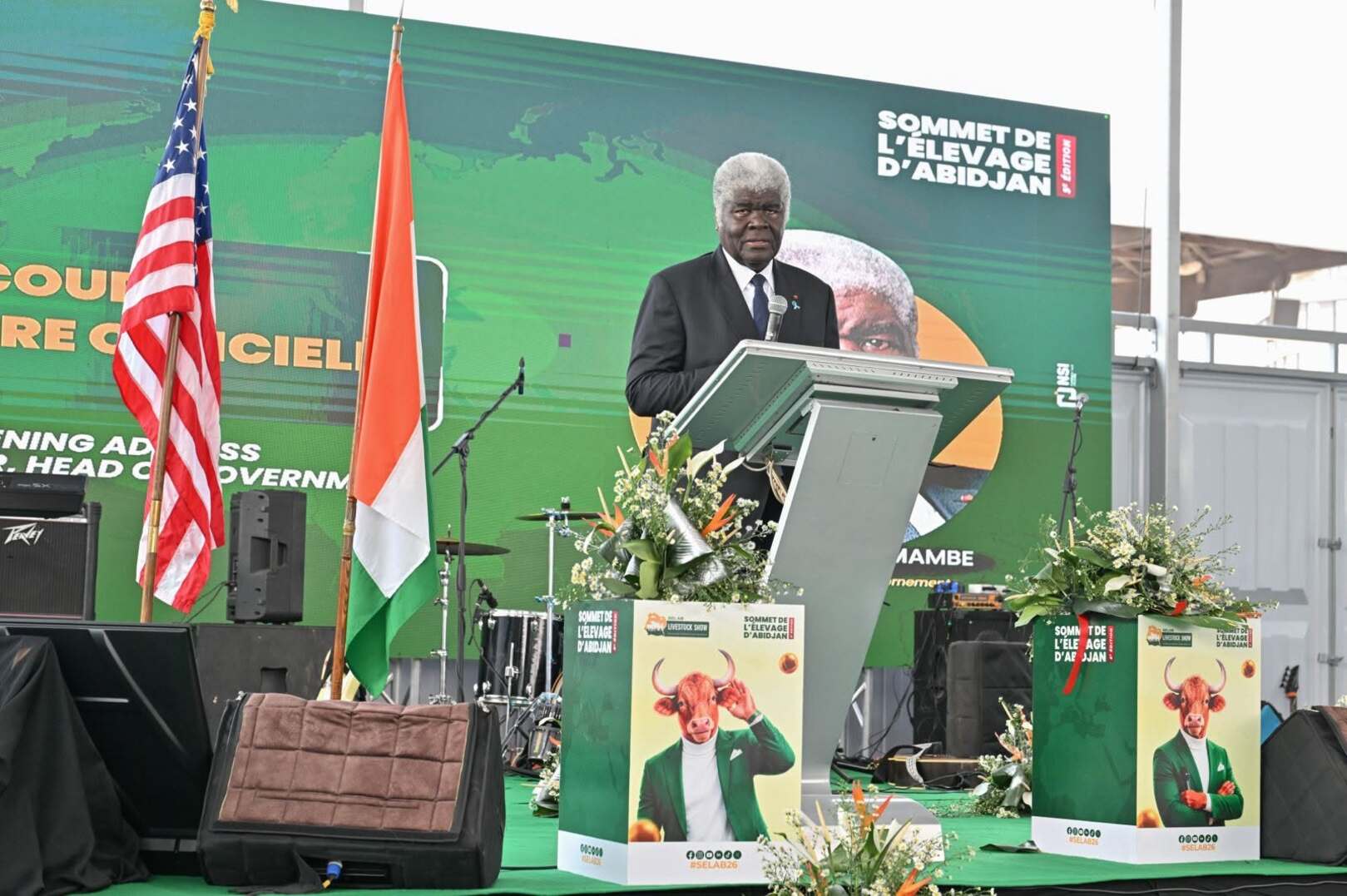
Côte d’Ivoire is seeking to accelerate the development of its livestock sector to reduce dependence on food imports, strengthen food sovereignty and create new economic opportunities. The sector has the potential to generate more than CFA francs 600 billion in annual revenue, Prime Minister Robert Beugré Mambé said during the opening of the fifth edition of the Abidjan Livestock Summit (SELAB 2026).
Held from November 20 to 22 at the Palais des Sports in Treichville, the summit brings together public and private sector stakeholders under the theme, “Animal Economy: A Driver of Wealth and Food Sovereignty.”
For the Ivorian authorities, the challenge goes beyond increasing livestock production. It involves building a competitive industry capable of meeting domestic demand, generating employment and expanding local processing activities.
Minister of Animal and Fisheries Resources Sidi Tiémoko Touré said the sector involves more than 700,000 direct jobs and supports a substantial number of indirect economic activities.
However, the sector's economic potential contrasts with the country's production shortfalls. Between 2020 and 2023, Côte d’Ivoire recorded average annual meat production of 187,472 tonnes, compared with average consumption of 407,544 tonnes, according to data from the African Development Bank. The gap is also significant in the dairy industry, where average annual production stood at 36,278 tonnes against consumption of 245,258 tonnes over the same period.
In 2024, imports of meat and offal reached 164,269 tonnes in carcass-weight equivalent, highlighting the country's continued reliance on foreign supplies to meet domestic demand.
This dependence represents both a food security challenge and an investment opportunity. Expanding cattle, pig and poultry farming, aquaculture, animal feed production, as well as storage and processing infrastructure could help strengthen domestic production capacity.
The main challenge, however, remains improving the competitiveness of local producers, particularly through better access to financing, affordable inputs, animal healthcare, lower production costs and more efficient marketing channels.
Through SELAB 2026, the government aims to mobilise economic and technical partners around these priorities. The United States is the guest country of honour at this year's edition, which also welcomes representatives from other African countries, including South Africa and Botswana.
For Côte d’Ivoire, the priority is to turn the livestock sector's economic potential into tangible production capacity, gradually reduce import dependence and retain a greater share of value added within the national economy.