

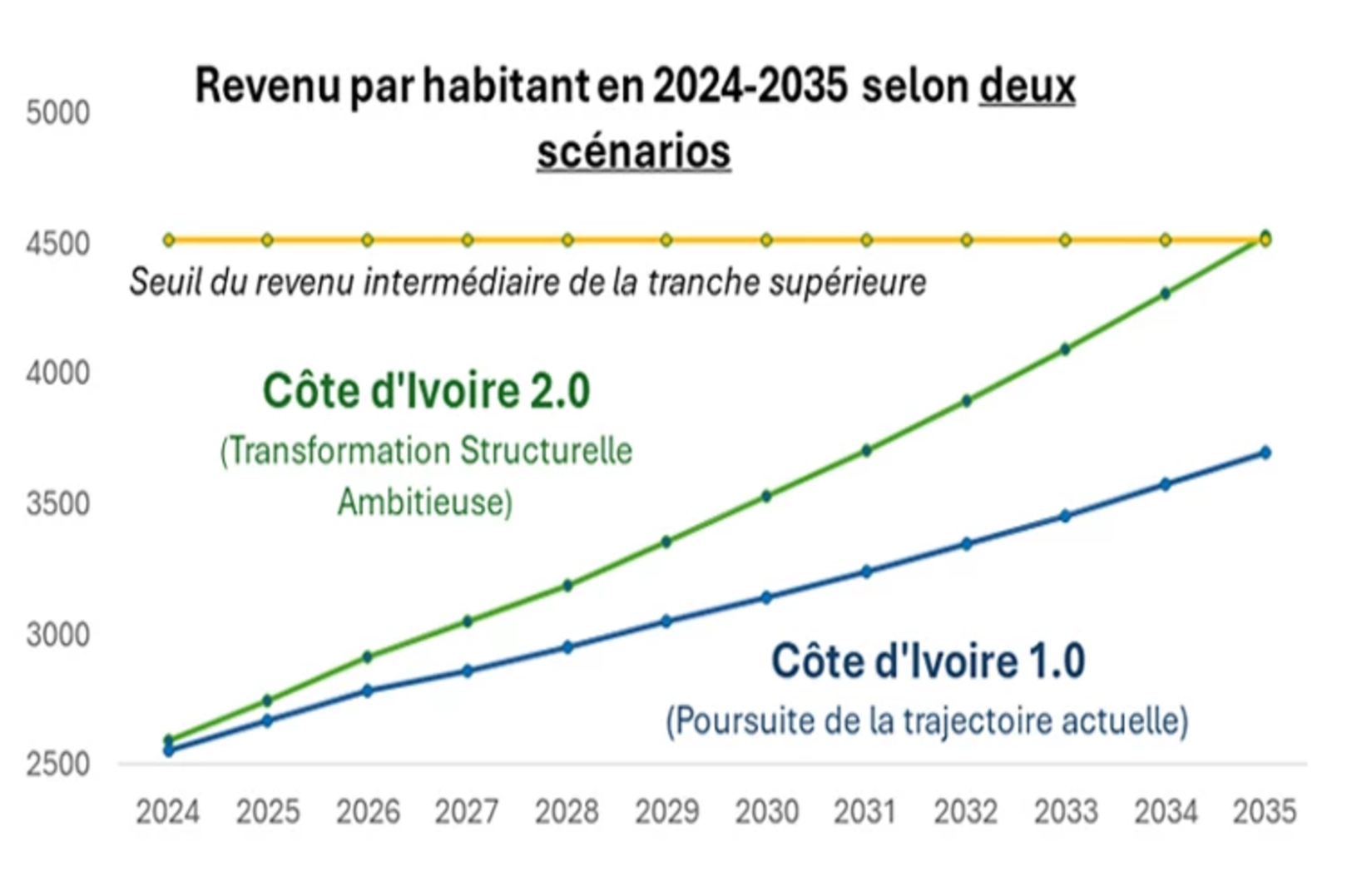
Côte d’Ivoire has set ambitious development targets for the 2030–2035 period, according to an analysis published by the World Bank on its official Africa Can End Poverty blog. These objectives include integrating around four million people into the labor market, cutting poverty by half, and achieving upper-middle-income country status by 2035.
According to the World Bank, these goals build on the country’s strong economic performance over the past decade, during which Côte d’Ivoire has been one of Africa’s fastest-growing economies. However, the institution notes that this growth has not always been sufficiently inclusive to absorb the growing labor force or significantly reduce poverty levels.
The analysis highlights that Côte d’Ivoire’s economy still relies largely on capital accumulation and labor expansion, rather than on substantial productivity gains. To address this challenge, the World Bank identifies several priority areas, including improving agricultural productivity, strengthening human capital through education, health, and vocational training, and increasing private and foreign investment.
The report also emphasizes the importance of stronger policy coordination and improved state implementation capacity to ensure that economic growth translates into tangible benefits for the population.
Ultimately, the World Bank concludes that achieving the 2030–2035 development objectives will depend on Côte d’Ivoire’s ability to renew its growth model and make it more inclusive, sustainable, and job-creating.