

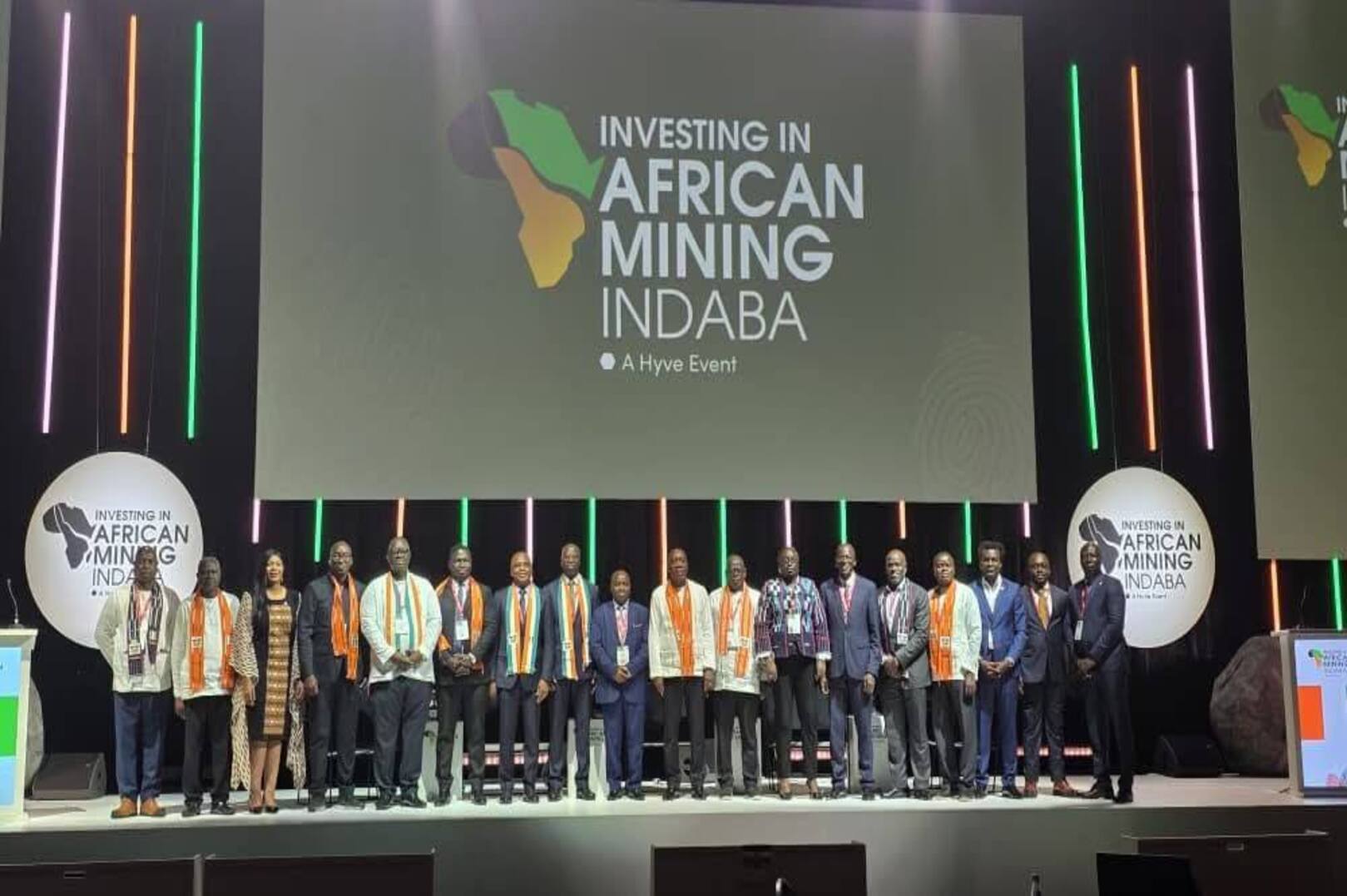
On the second day of the Mining Indaba forum, Côte d’Ivoire dedicated a session to promoting its mining sector. More than a hundred participants, including several international investors, attended the meeting, which featured an institutional presentation, a panel discussion, and testimonials from companies operating in the country.
Ten Years of Growth and Sector Structuring
The presentation, titled “10 Years of Mining Growth: Outcomes of Multi-Stakeholder Governance,” was delivered by Seydou Coulibaly, Director General of Mines and Geology. He highlighted that the past decade has been marked not only by sustained growth but also by institutional strengthening of the Ivorian mining sector, with a cumulative investment volume exceeding 2,000 billion CFA francs.
According to Seydou Coulibaly, these results are the outcome of multi-stakeholder governance based on transparency. He noted that Côte d’Ivoire was ranked by the Fraser Institute in 2022, 2023, and 2024 as the best mining jurisdiction in West Africa, the top investment destination in the subregion, and among the top 10 most attractive jurisdictions on the African continent. The country is also recognized as one of the best places in the world to develop a gold mine, as evidenced by the presence of around ten international mining companies operating there.
Structural Advantages and Confirmed Geological Potential
The Director General of Mines and Geology also emphasized several factors favorable to investment: political stability, a national security index of 1.2 in 2024, modern infrastructure, available energy supply, and a skilled workforce.
From a geological perspective, he pointed out that Côte d’Ivoire possesses 35% of the Birimian rocks of West Africa, making it rich in gold and other commodities; 18.6% of Archean formations contain base metals. Furthermore, indicators for most sought-after minerals have been identified across the national territory.
An Expanding Mining Sector and Modernizing Regulatory Framework
Currently, Côte d’Ivoire has 19 operational mines, including 13 gold mines, 4 manganese mines, one bauxite mine, and one nickel mine. Coulibaly also mentioned the existence of other mineral resources of interest, including chrome, coltan, lithium, copper, cobalt, molybdenum, diamond, and iron.
He further discussed ongoing reforms aimed at enhancing the attractiveness of the legal and institutional framework. These include revising the mining code, modernizing the mining cadastre to ensure transparency, actively participating in the Extractive Industries Transparency Initiative (EITI), and ensuring compliance with the principles and requirements of the Kimberley Process.
Prior to this presentation, His Excellency Sakaria Koné, Ambassador of Côte d’Ivoire to South Africa, representing Sangafowa-Coulibaly, Minister of Mines, Petroleum and Energy, urged investors to explore and join a Ivorian model in which investment profitability is framed within a partnership approach: a framework where the state, the private sector, and local communities advance together while respecting environmental and social standards, in line with the Sustainable Development Goals. “I encourage you to seize this opportunity to create new prospects, strengthen your networks, and forge strategic alliances. (…) Côte d’Ivoire is not only ready for investment; it is ready for long-term partnerships capable of building the mines of tomorrow – more competitive, responsible, and inclusive mines,” he said.
Arnaud Kouassi, Technical Advisor and head of the Ivorian delegation, concluded by emphasizing that “Côte d’Ivoire is today establishing itself as a credible, competitive, and stable mining destination.”
The Ivorian delegation invited investors to Abidjan for SIREXE 2026, scheduled from November 18 to 22, 2026, to move from dialogue to action, not only in mining but also in petroleum and energy sectors.
The day was attended by Jean-Luc Assi, Chairman of the Board of Sodemi, members of the GPMCI (Groupement des Miniers de Côte d’Ivoire), and private operators involved in the Ivorian mining value chain.