

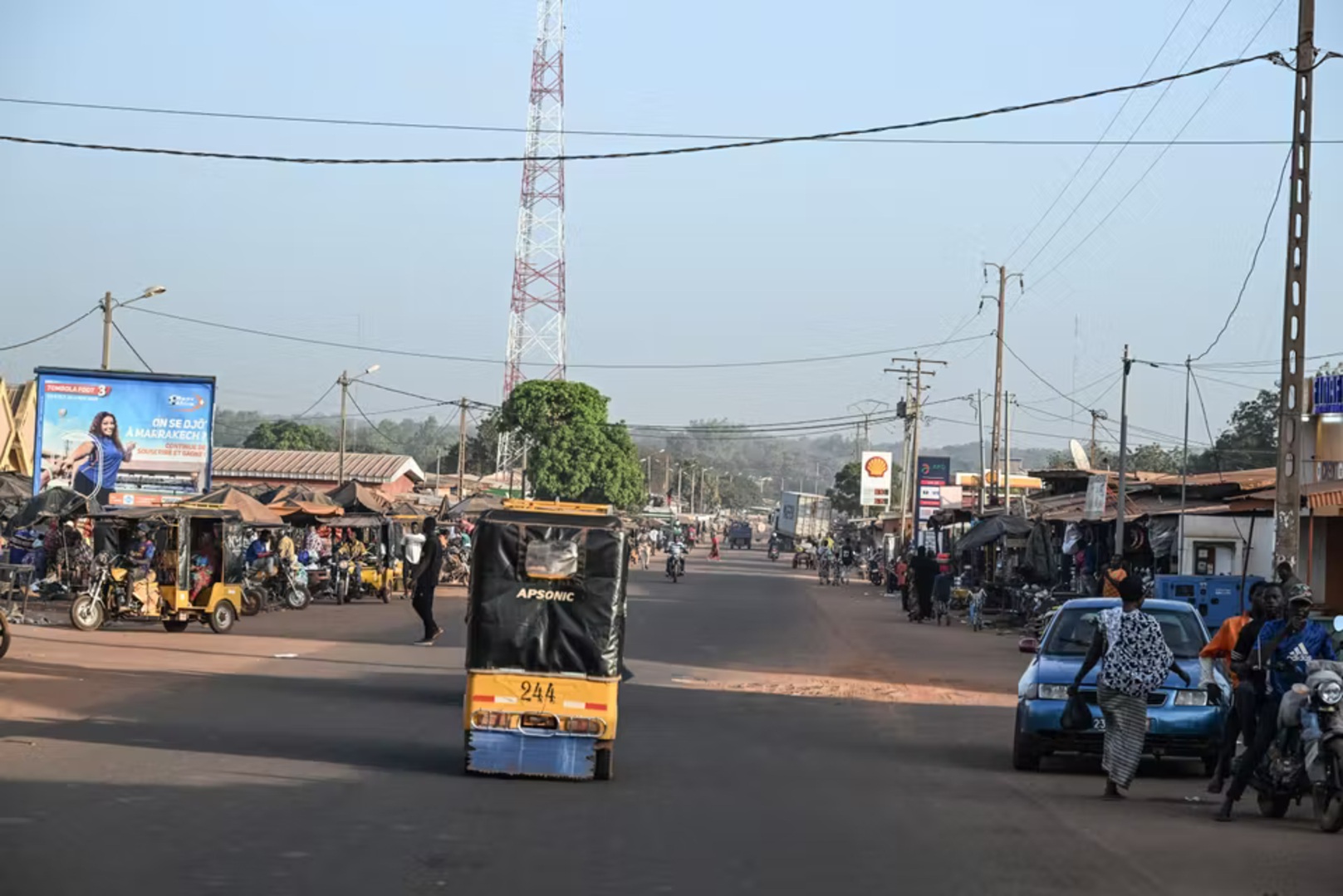
This population movement is believed to be the result of “attacks carried out against civilians by armed terrorist groups in southern Mali,” according to Côte d’Ivoire’s National Security Council.
The Ivorian government announced on Thursday, November 13, that it is reinforcing security along its northern border in response to an “unusual” influx of Malian refugees fleeing attacks by “armed terrorist groups” in southern Mali.
Since September, the Group for the Support of Islam and Muslims (GSIM), an Al-Qaeda–affiliated organization, has been targeting fuel tankers transporting petroleum products from Senegal and Côte d’Ivoire—routes through which most goods destined for Mali transit. Several vehicles have been burned, and both drivers and soldiers have been killed near the Ivorian border.
On Wednesday, hundreds of people fled the area around Loulouni, located 50 kilometers from the Ivorian border, toward other Malian towns after a jihadist attack on traditional Dozo hunters, local sources told Agence France-Presse (AFP).
In a statement released Thursday, the National Security Council (CNS), which brings together the country’s security apparatus, said it had “been informed of several unusual flows of refugees arriving from Mali.” “These flows appear to be caused by attacks carried out against civilians by armed terrorist groups in several localities in southern Mali,” the statement continued, ordering the “registration of these asylum seekers.”
Election Security Measures
The CNS also instructed the Chief of the General Staff of the Armed Forces to take appropriate measures to strengthen security along the northern borders.
Côte d’Ivoire already hosts around 90,000 refugees from neighboring Burkina Faso, which is also facing jihadist violence as well as attacks by pro-government militias.
During its meeting on Thursday, the CNS also addressed the issue of securing the legislative elections scheduled for December 27. It first welcomed the “smooth conduct” of the October presidential election, despite “some incidents” that resulted in 11 deaths, 71 injuries, and 1,658 arrests, according to its report. The opposition, however, claims a death toll of 27 during the campaign and on election day.
The CNS announced that the 44,000 defense and security personnel already deployed for the presidential election would remain in place to secure the legislative elections. It also decided to extend by one month—until January—the ban on demonstrations issued in October for political parties and groups, “except for those that fall within the framework of the electoral process.”