

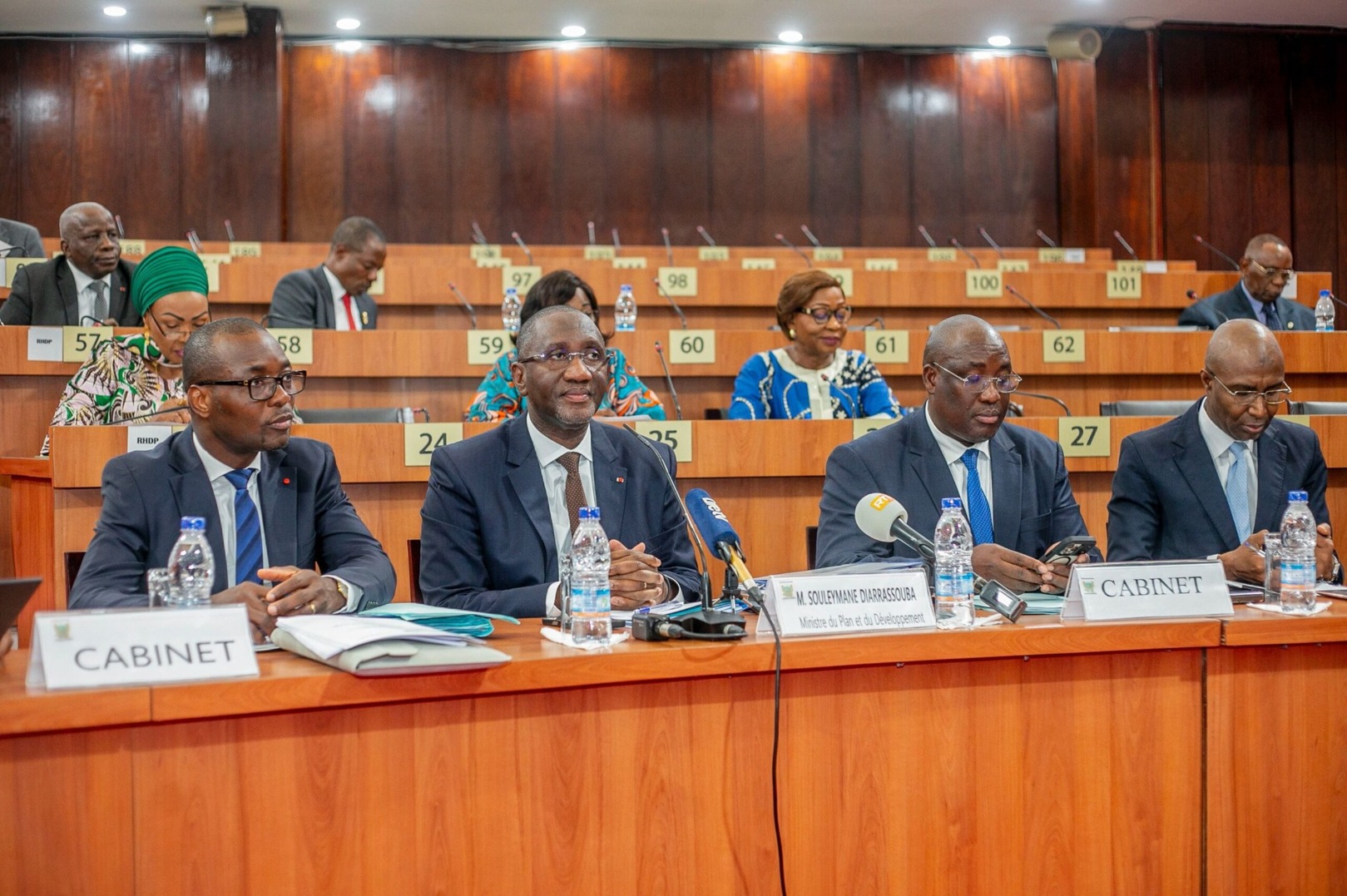
The Economic and Financial Affairs Committee of the National Assembly of Côte d'Ivoire unanimously adopted, on Tuesday, April 7, 2026 in Abidjan, the draft law on the National Development Plan (PND) for the 2026–2030 period.
Presented by the Minister of Planning and Development, Dr. Souleymane Diarrassouba, acting on behalf of the Government, the draft law aims to provide Côte d'Ivoire with a legal framework to guide its medium-term development strategy.
The legislative anchoring of the PND strengthens the country’s economic direction, ensures the consistency of public action over time, and enhances the credibility of the State’s commitments toward economic and financial partners.
With an overall budget of 114,838.5 billion CFA francs, 70.2% of which is expected to be financed by the private sector, the 2026–2030 PND sets a clear objective: to increase per capita income to USD 4,500 by 2030. It outlines the structural transformation of the Ivorian economy around six key pillars: “Peace, Security and Stability,” “Agriculture and Agro-industry,” “Private Sector and Industrialization,” “Human Capital,” “Infrastructure,” and “Governance.”
The plan promotes an economic strategy based on productive investment, human capital development, and the strengthening of the private sector as the main driver of growth—three pillars aligned with the United Nations Sustainable Development Goals (SDGs) and the African Union’s Agenda 2063.
The PND 2026–2030 was developed through a participatory process involving all national stakeholders. It is supported by a performance-based governance and monitoring framework aimed at evaluating public policies.
Parliamentary groups commended the quality of the presentation by the Government’s representative and the clarity of the responses provided to their questions.
“The 2026–2030 PND embodies an economic vision based on productive investment, human capital development, and the strengthening of the private sector. By giving it a legislative foundation, we ensure the consistency and continuity of public action in support of the sustainable transformation of our economy,” said Dr. Souleymane Diarrassouba.
The committee’s adoption paves the way for review in a plenary session of the National Assembly, a necessary step before the bill is submitted to the Senate, in accordance with the constitutional procedure in force.