

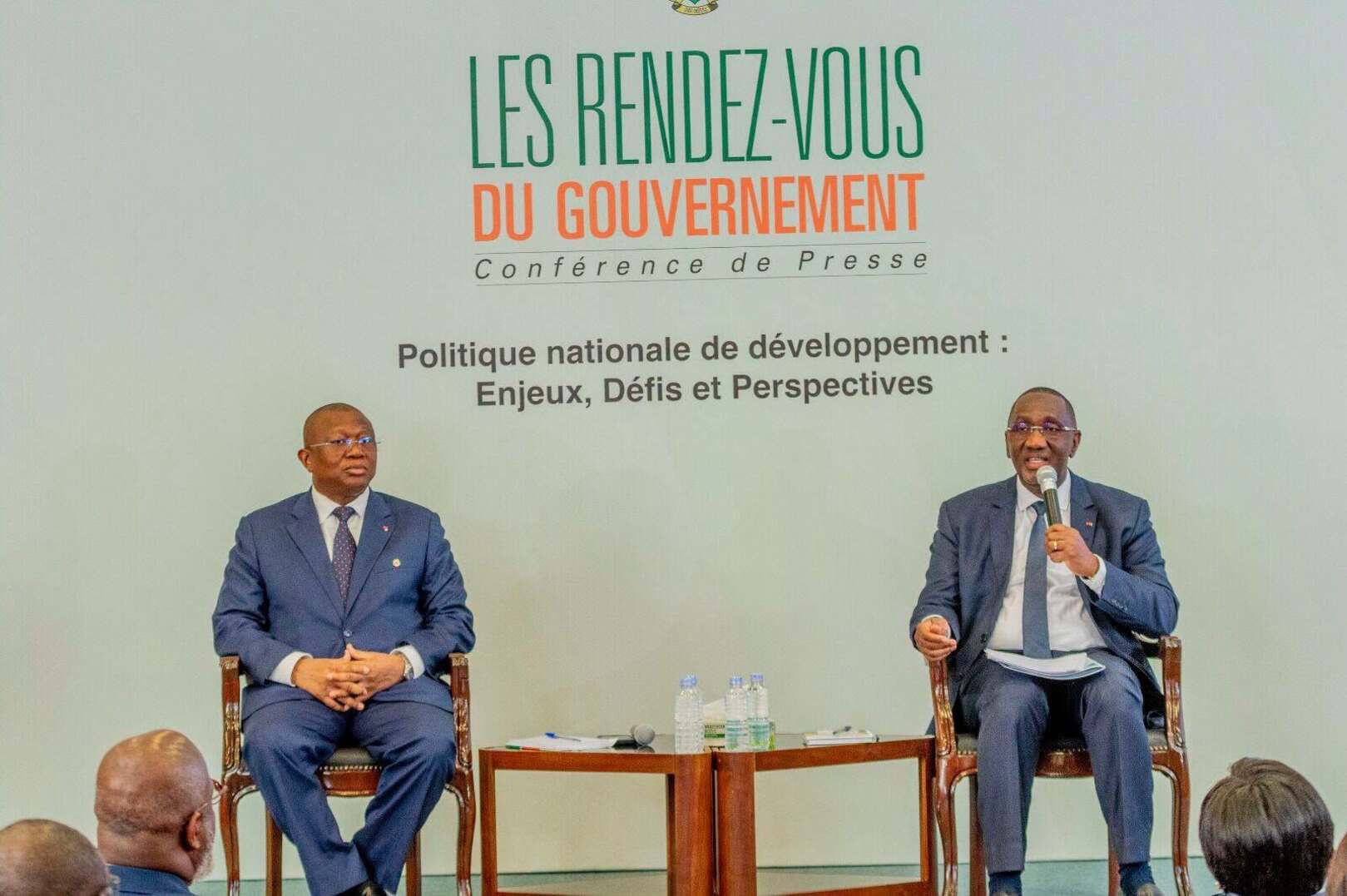
Guest of the press conference "Les Rendez-vous du Gouvernement", organized by the Government Information and Communication Centre (CICG) on Monday, 20 July 2026 at the Prime Minister’s Office auditorium in Abidjan-Plateau, Minister of Planning and Development Souleymane Diarrassouba spoke on the theme "National Development Policy: Challenges, Issues and Prospects."
In the presence of the Minister of Communication and Government Spokesperson Amadou Coulibaly, who also moderated the conference, Minister of State Anne Désirée Ouloto, CICG Director Awa Dosso, representatives of the United Nations System, media institution leaders, and journalists, Souleymane Diarrassouba discussed the evolution of Côte d’Ivoire’s national development policy and planning process, the country’s economic and social performance since 2012, and the prospects linked to the implementation of the NDP 2026–2030.
Regarding the various stages of national planning policy, the Minister recalled the period of economic prosperity from the 1960s to the 1980s, commonly known as the "Ivorian miracle", during which the country recorded an average real annual growth rate of 7.3%. From 1980 to 2010, four Structural Adjustment Programmes (SAPs) were implemented between 1981 and 1992. Between 2000 and 2010, Côte d’Ivoire implemented the Poverty Reduction Strategy Paper (PRSP).
During the 1980–2010 period, the Minister noted that economic growth remained weak, averaging 1.3%, while the poverty rate, which stood at only 10% in 1985, rose to 48.9% in 2008 and 55.4% in 2011.
However, since 2012, Souleymane Diarrassouba explained that the revival of the national development policy has been based on five-year National Development Plans (NDPs), including the NDP 2016–2020, with a total cost of 30,000 billion CFA francs, the NDP 2021–2025, with a total cost of 59,000 billion CFA francs, and the NDP 2026–2030, estimated at 114,838.5 billion CFA francs.
Regarding economic and social performance since 2012, he highlighted that real GDP growth averaged 8.1% between 2012 and 2019, slowed to 0.7% in 2020 due to the COVID-19 pandemic, before rebounding to an average of 6.5% over the 2021–2025 period. GDP per capita doubled, increasing from US$1,546.9 (789,803 CFA francs) in 2012 to US$3,148.2.
On the social front, massive investments in economic infrastructure, education, healthcare, electricity, drinking water, housing, and human capital have significantly improved the living conditions of the population. The Productive Social Safety Nets Programme has benefited 527,000 households since its launch in 2017, with a cumulative investment of more than 156 billion CFA francs.
Regarding the prospects for implementing the NDP 2026–2030, Souleymane Diarrassouba stated that the government’s ambition is, among other objectives, to achieve an average annual growth rate of 7.2%, with economic growth increasing from 6.7% in 2026 to 7.6% in 2030; raise GDP per capita from US$3,148.2 to US$4,500, representing a 43% increase; reduce the poverty rate from 37.5% to below 20%; increase the employed population from 11.5 million to 14 million people; improve the Human Capital Index from 0.38 to 0.7; and accelerate the local processing of raw materials, including cocoa from 42% to 50% and cashew from 45% to 70%.
During his exchange with journalists and online participants, the guest of "Les Rendez-vous du Gouvernement" reassured the audience about concerns regarding debt sustainability. He stated: "On 24 June 2026, the IMF and the World Bank classified Côte d’Ivoire among the countries at low risk of debt distress, both for external debt and total public debt: a first in sub-Saharan Africa within the framework of debt sustainability assessments for low-income countries."
According to him, the success of the NDP Consultative Group meeting held on 8 and 9 July 2026 demonstrates that Côte d’Ivoire is a trusted and attractive destination, with promising development prospects.
He also stated that the NDP 2026–2030 will address in depth issues related to technical and vocational education, social housing, the promotion of national champions, the fight against illegal gold mining, the strengthening of road infrastructure, and mass transportation systems such as railways and Bus Rapid Transit (BRT).
Speaking about the General Population Census, the Minister announced that Côte d’Ivoire’s population is expected to reach 36 million inhabitants by 2030.
Regarding spatial planning and territorial development, Souleymane Diarrassouba stated that the new NDP will provide solutions to rural poverty through the creation of nine regional economic hubs and through a reform of the territorial civil service, aimed at enabling regions to become engines of economic growth.