

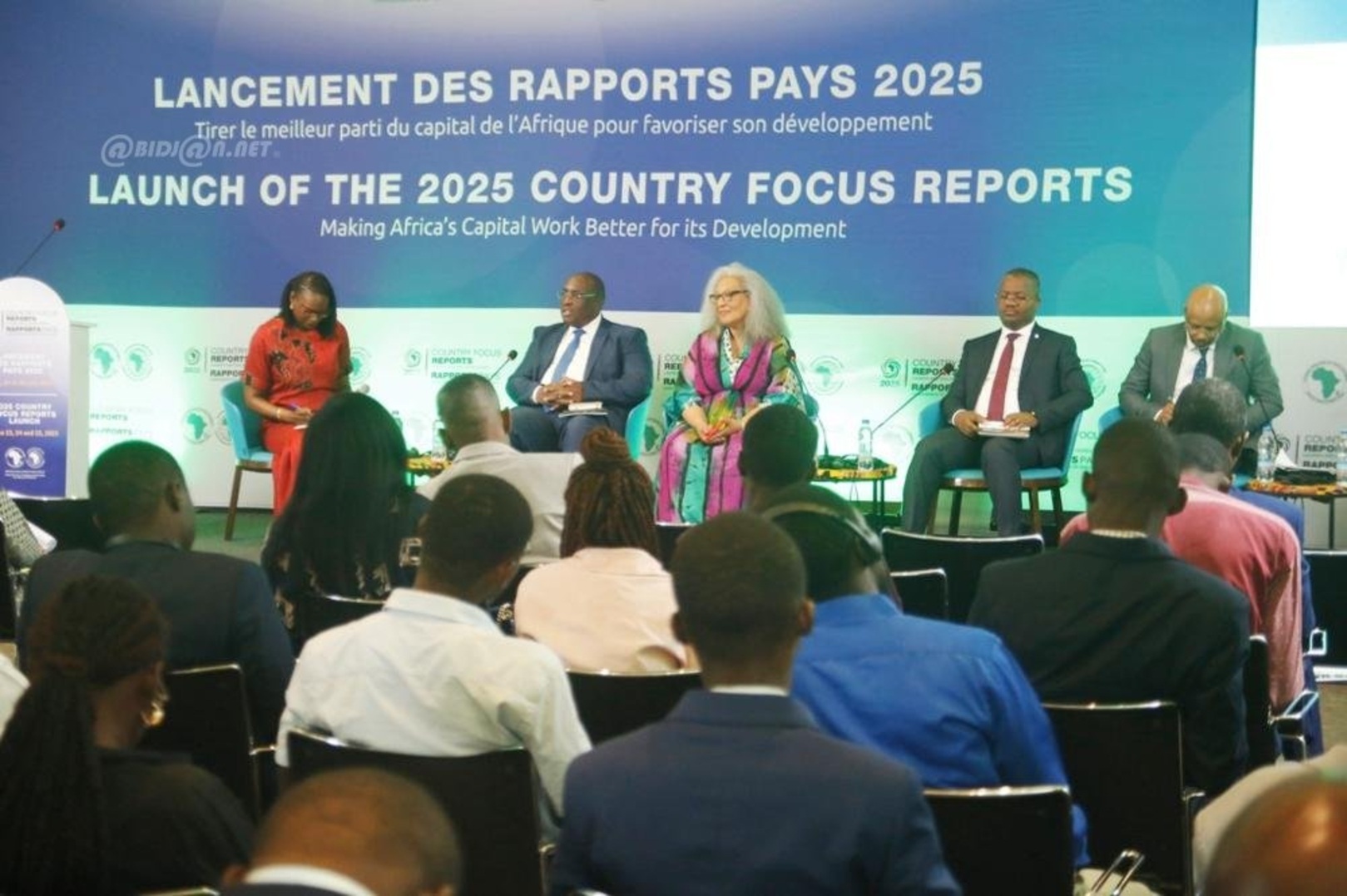
African Development Bank Launches 2025 Country Reports, Including Côte d’Ivoire’s, in Abidjan
Theme: “Harnessing Africa’s Capital for Development”
On Monday, June 23, 2025, the African Development Bank (AfDB) officially launched its 2025 Country Reports, including that of Côte d’Ivoire, at a ceremony held in Abidjan. This year’s central theme is: "Harnessing Africa’s Capital for Development."
According to AfDB representatives, these annual reports provide an in-depth analysis of the economic, social, and structural situation in each of the Bank's regional member countries. They highlight domestic levers that states can activate to accelerate their economic transformation.
The 2025 reports focus on several key areas:
-
Human capital development, particularly through education, healthcare, and vocational training
-
Efficient domestic resource mobilization, including tax reforms and the fight against illicit financial flows
-
Sustainable use of natural resources
-
Investment in innovation, entrepreneurship, and local value chains
Each country report includes a tailored diagnosis and recommendations adapted to the realities of each state. They feature updated data, key economic indicators, and growth scenarios, aiming to serve as a strategic decision-making tool for governments and development partners.
Speaking at the launch, Dr. Marcellin Ndong Ntah, Lead Economist for the AfDB in Côte d’Ivoire, emphasized that the reports showcase the abundant capital potential in Africa:
“The reports reveal or confirm that Africa has abundant capital resources, which must be mobilized and used rationally and efficiently to contribute to the development of our countries,” he said.
“They highlight concrete opportunities and propose ambitious, structured, and measurable action plans for monitoring and accelerating the continent’s structural transformation. They are not only rigorous diagnostic tools, but true roadmaps.”
Dr. Ndong explained that the theme was chosen to raise awareness of Africa’s rich and diverse capital, from natural to human, entrepreneurial, and financial.
Côte d’Ivoire: Strong Growth but Structural Challenges Remain
Prof. Kevin Urama, Chief Economist and Vice President for Knowledge and Governance at the AfDB, praised Côte d’Ivoire’s “impressive” GDP growth and stated:
“If Côte d’Ivoire improves governance and institutional capacity, it can double its current growth rate.”
He also noted that the informal sector contributes 30 to 40% of the country’s economy.
Officially launching Côte d’Ivoire’s country report, Professor Clément Kouakou, Deputy Chief of Staff at the Ministry of Economy, Planning, and Development (representing Minister Nialé Kaba, AfDB Governor for Côte d’Ivoire), outlined the government’s efforts to mobilize capital and fund national priorities, while reaffirming its commitment to continue structural reforms that foster a sustainable development environment.
Kadio Lionel Kouao, Country Economist at the AfDB and lecturer at the ENSEA (National School of Statistics and Applied Economics), presented the country report for Côte d’Ivoire. He highlighted:
-
A real GDP growth rate of 6.1% in 2024, with projections of around 6.3% for 2025–2026
-
Inflation is decreasing, at 3.5% in 2024 compared to 4.4% in 2023
-
The budget deficit has narrowed to 4% of GDP, down from 5.2% the previous year
However, resource mobilization remains weak. The tax-to-GDP ratio stands at 13.8%, well below the regional benchmark of 20%. Key challenges include:
-
The weight of the informal sector
-
Underutilized fiscal levers (e.g., property tax, e-commerce taxation)
-
Insufficient investment in human capital, particularly in health, training, and skills-matching for the labor market
-
An underutilized natural capital (95% renewable), due to the absence of effective environmental accounting
-
The need to fight corruption, secure land rights, and improve the business climate to attract investment
According to the AfDB, Côte d’Ivoire will need to mobilize USD 3.2 billion annually (about 3.5% of GDP) to reach its Sustainable Development Goals (SDGs) by 2030.
Experts Share Insights on Economic Transformation
During a panel discussion titled “Harnessing Côte d’Ivoire’s Capital for Development,” moderated by Dr. Linguère Mbaye, Head of Division at the AfDB’s Country Economics Department for the North, Central, and West Africa regions, several experts shared insights on how to accelerate the country's transformation.
Marcelin Cissé, Director General of Planning at the Ministry of Economy, Planning, and Development, stressed the importance of creating a stable socio-economic environment and improving the rate of financial inclusion:
“Our challenge is to develop a stable socio-economic environment and increase the banking rate,” he said.
Dr. Joseph Ribeiro, Deputy Director General for West Africa at the AfDB, reaffirmed the Bank’s commitment to Côte d’Ivoire:
“The AfDB is deeply engaged in various sectors in the country. It is the second-largest funder of the rural sector after the government,” he said.
He also advocated for digital systems to support youth integration:
“Being young is an asset — but only if paired with qualifications. The real barrier in Africa is the lack of skills.”
Dr. Hugues Kouadio, Director General of ENSEA, emphasized the need to revalue certain professions that remain undervalued despite their strong potential in the economic fabric.
Dr. Marcellin Ndong Ntah added that:
“Formalizing the informal sector is crucial for it to fully contribute to the national economy.”
The event brought together policymakers, economists, technical and financial partners, and private sector representatives, all committed to shaping the future of Côte d’Ivoire’s development.