

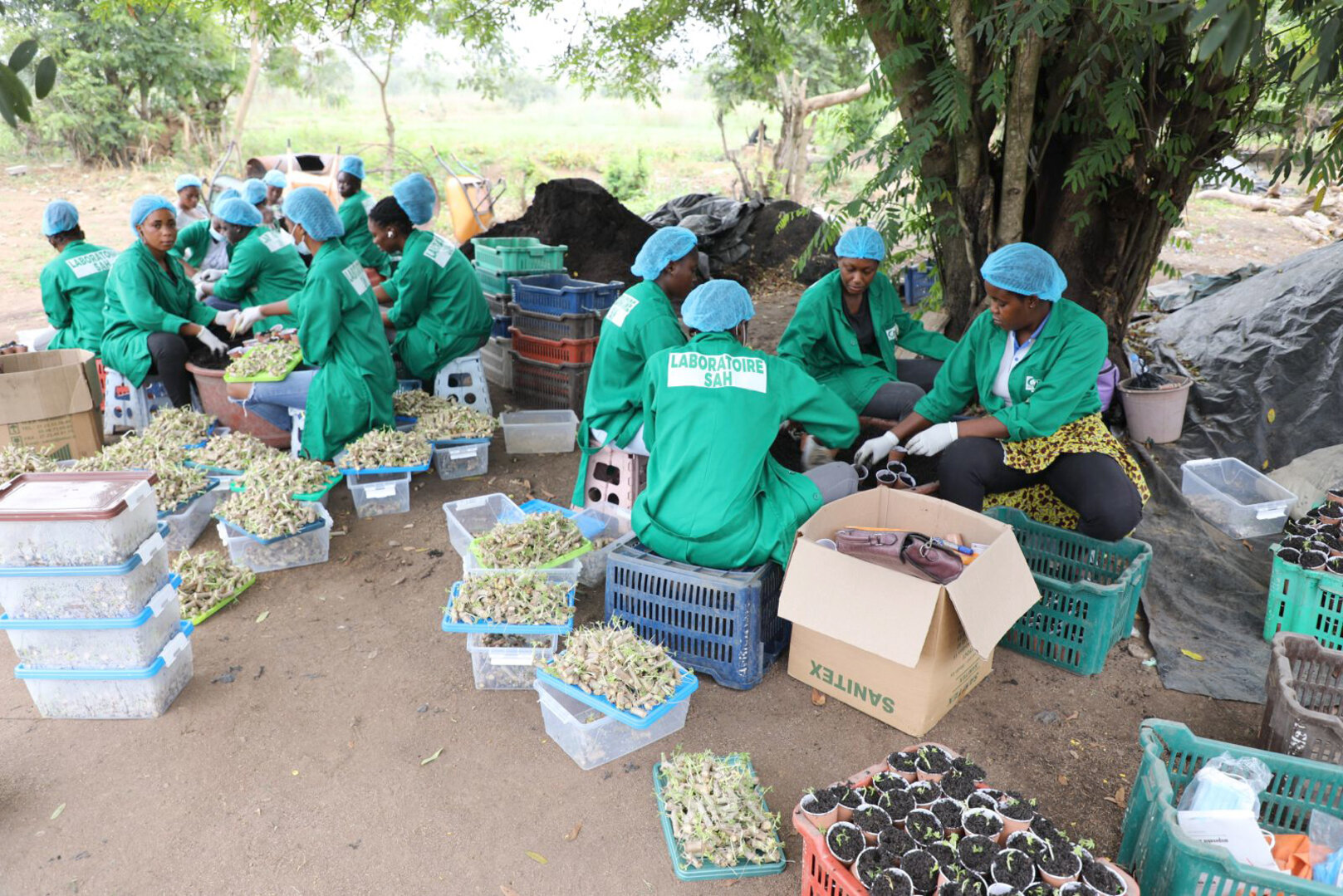
The National Center for Agronomic Research (CNRA) in Bouaké has introduced major innovations in its techniques to boost national capacity for producing high-quality cassava seeds. This modernization supports the rapid multiplication of cassava planting material, which plays a crucial role in food security in Côte d’Ivoire.
With substantial support from the Ivorian government and the World Bank — the main donor of the Food Crops Value Chain Development Project (PDC2V) — the CNRA now has powerful tools, thanks to newly acquired laboratories, greenhouses, tunnels, and modern equipment.
According to Dr. Diby Konan, head of the SAH project (Semi-Autotrophic Hydroponics), the process relies on rapid multiplication of plants through In Vitro Culture (IVC). “This method allows us to obtain healthy plantlets, free from viruses and diseases. It is an essential step to ensure seed quality,” he explained.
The process begins with the sanitation of local varieties in the laboratory before they are multiplied under controlled conditions. In a short period of time, the plantlets develop roots, stems, and leaves, becoming ready for field transfer — significantly reducing production time.
Dr. Diby Konan further emphasized that “the plants are natural, simply sanitized and multiplied more quickly,” noting that Ivorian legislation does not authorize the production or dissemination of Genetically Modified Organisms (GMOs). Thanks to the SAH technique, a single plantlet can produce up to 50 new ones per year, compared to 10 to 15 previously.
“In three weeks, we obtain viable plantlets ready for planting. While the traditional method required six months, we now save more than two months in the production cycle,” added Dr. Essis Brice, a CNRA researcher.
The CNRA is currently working with pilot producers to test this technique on a large scale within the PDC2V Project and the second-generation National Agricultural Investment Program (PNIA 2).
It is worth noting that this technology, previously used on yam five years ago, has now been adapted to cassava. Thanks to this major innovation, the CNRA is capable of producing the equivalent of five hectares of cassava plantlets per day, depending on available plant material. The Center also manufactures its own substrates — previously imported from Kenya or Nigeria — gaining full technical autonomy.