

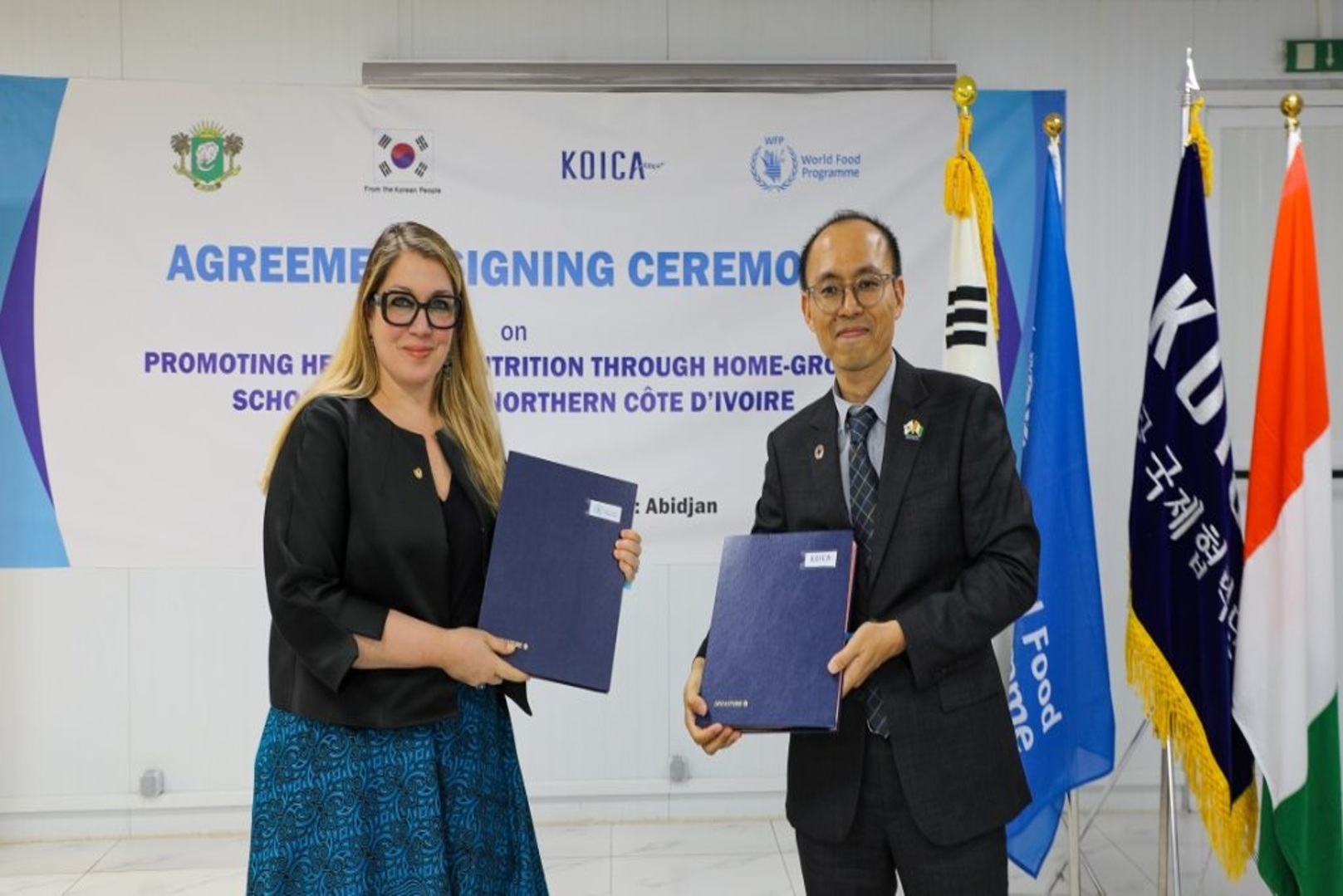
The United Nations World Food Programme (WFP) announced on Tuesday, October 14, 2025, the receipt of a US$9.3 million contribution from the Government of the Republic of Korea, aimed at improving health, nutrition, and food security, while promoting inclusive development in northern Côte d’Ivoire.
This multi-year funding, provided through the Korea International Cooperation Agency (KOICA), will enable the WFP to deliver nutritious, locally sourced school meals to 50,000 pupils across 200 primary schools in the Bagoué, Bounkani, Poro, and Tchologo regions. The initiative, which runs from 2025 to 2029, seeks to enhance students’ well-being, concentration, and academic performance.
In parallel, the WFP will support 100 smallholder farmers’ groups through training and technical assistance to improve both the quality and quantity of their production. A direct supply chain will connect these producers to school canteens, thereby stimulating rural economies, strengthening local value chains, and ensuring long-term sustainability.
“Our partnership with KOICA represents an investment in Côte d’Ivoire’s future,” said Olivia Hantz, WFP Representative and Country Director in Côte d’Ivoire. “By strengthening national systems and empowering local producers, we ensure that each school meal not only nourishes children’s learning and health but also contributes to the country’s food security and resilience.”
Beyond providing meals, the initiative will also promote handwashing facilities in schools and enhance education on hygiene, health, and nutrition for students and surrounding communities — adopting a holistic approach to school and community well-being.
The program will be implemented in close collaboration with the Government of Côte d’Ivoire, notably the Ministry of National Education and Literacy (through the Directorate of School Canteens), the Ministry of Agriculture and Rural Development, and the Ministry of Health and Public Hygiene.
This multi-sectoral approach leverages expertise from education, health, and agriculture to build a resilient and sustainable school feeding system, aligned with national priorities.
“This project holds special meaning for us,” said Kim Sangjun, KOICA Country Director in Côte d’Ivoire. “It reflects a lesson deeply rooted in Korea’s own history — the belief that a simple nutritious meal can unlock a child’s potential, and that these healthy, thriving children form the very foundation of a nation’s prosperity. By linking schools to local producers, we are investing in that foundation.”
Currently, the WFP provides school meals to over 166,000 pupils in 733 schools across Côte d’Ivoire, demonstrating the organization’s strong commitment to children’s well-being and academic success.
“This new funding marks an important milestone in the fight against food insecurity in Côte d’Ivoire,” concluded Olivia Hantz. “By improving children’s nutrition and education through a sustainable, locally sourced school feeding program, WFP and KOICA are strengthening human capital and promoting inclusive development for the benefit of both children and their communities.”