

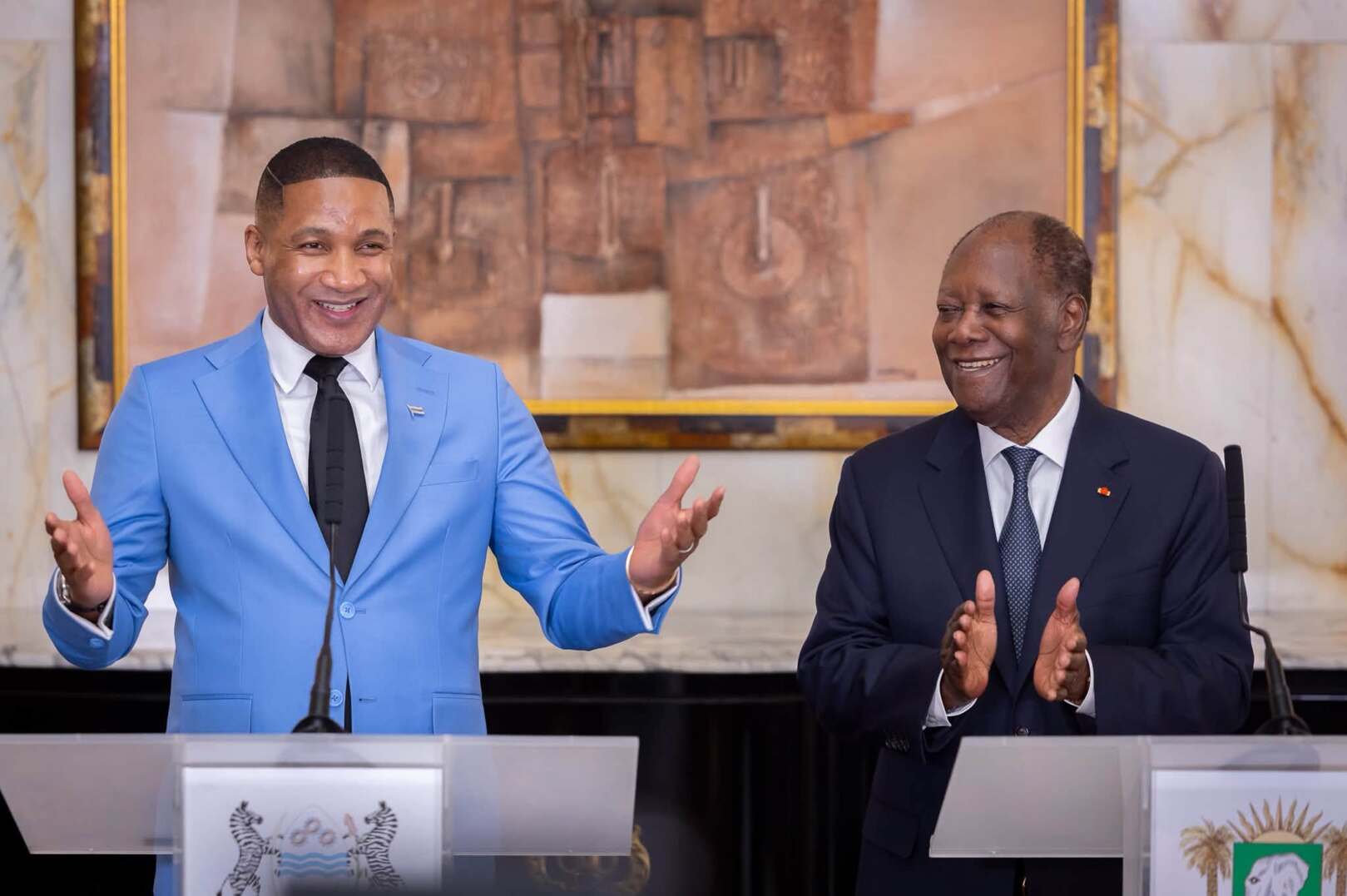
Côte d’Ivoire and Botswana sign seven agreements to strengthen economic cooperation
Côte d’Ivoire and Botswana have signed seven cooperation agreements covering mining, oil, energy, agriculture and diplomacy, as the two countries seek to deepen economic ties and expand trade.
The agreements were signed on Monday in Abidjan following talks between Ivorian President Alassane Ouattara and his Botswana counterpart, Duma Gideon Boko, who is on a state visit to Côte d’Ivoire.
The meeting, held at the Presidential Palace, aimed to give fresh momentum to bilateral relations and address the limited level of economic exchanges between the two countries.
Ouattara called on Botswana's businesses to invest in Côte d’Ivoire, particularly in the mining and energy sectors, as well as in projects included in the country's 2026-2030 National Development Plan.
Several of the seven agreements involve state-owned companies from both countries.
In the mining sector, Côte d’Ivoire's Society for Mining Development (SODEMI) and its Botswana counterpart have established a framework for cooperation focused on sharing expertise in diamond mining and critical and strategic minerals, as well as skills transfer.
In the oil sector, Côte d’Ivoire's national oil company PETROCI and Botswana Oil Limited signed a memorandum of understanding covering cooperation in exploration, production, joint investments and energy infrastructure development.
A separate agreement between the Ivorian Refining Company (SIR) and Botswana Oil Limited aims to strengthen cooperation in refining and energy infrastructure.
Other agreements cover general bilateral cooperation, political consultations, reciprocal visa exemptions for holders of diplomatic and service passports, and cooperation in animal resources and fisheries.
Beyond the diplomatic agreements, the two leaders highlighted the complementary nature of their economies.
Botswana has extensive experience in mineral resource management and diamond production, a key sector of its economy. Côte d’Ivoire, meanwhile, has significant agricultural and mining resources and is seeking to expand the local processing of raw materials.
Boko drew a comparison between Botswana's diamond industry and Côte d’Ivoire's cocoa sector, stressing the need for African countries to generate greater value from their natural resources rather than relying primarily on raw material exports.
The Botswana president also called for fewer administrative and trade barriers between African countries, advocating greater regulatory harmonisation and the development of trade corridors to facilitate cross-border commerce.
Boko's visit, scheduled from November 15 to 18, also has a strong economic focus. He is accompanied by a government delegation and around 60 business representatives.
A Côte d’Ivoire-Botswana business forum is scheduled for Tuesday, November 17, at the headquarters of the General Confederation of Businesses of Côte d’Ivoire (CGECI). The meeting is expected to provide companies from both countries with an opportunity to identify potential partnerships and investment opportunities.
Botswana will also take part in the second edition of the International Exhibition of Extractive and Energy Resources (SIREXE 2026) in Abidjan as the event's guest of honour.
For Abidjan and Gaborone, the next challenge will be to turn the agreements into concrete economic projects, particularly in mining, energy and the local processing of natural resources.