Africa’s foreign investment landscape shifts as Egypt, Guinea and Mozambique lead FDI inflows in 2025
Africa’s foreign direct investment (FDI) landscape is undergoing a major transformation, with countries rich in natural resources, expanding industrial sectors and ambitious infrastructure projects attracting the largest share of international capital.
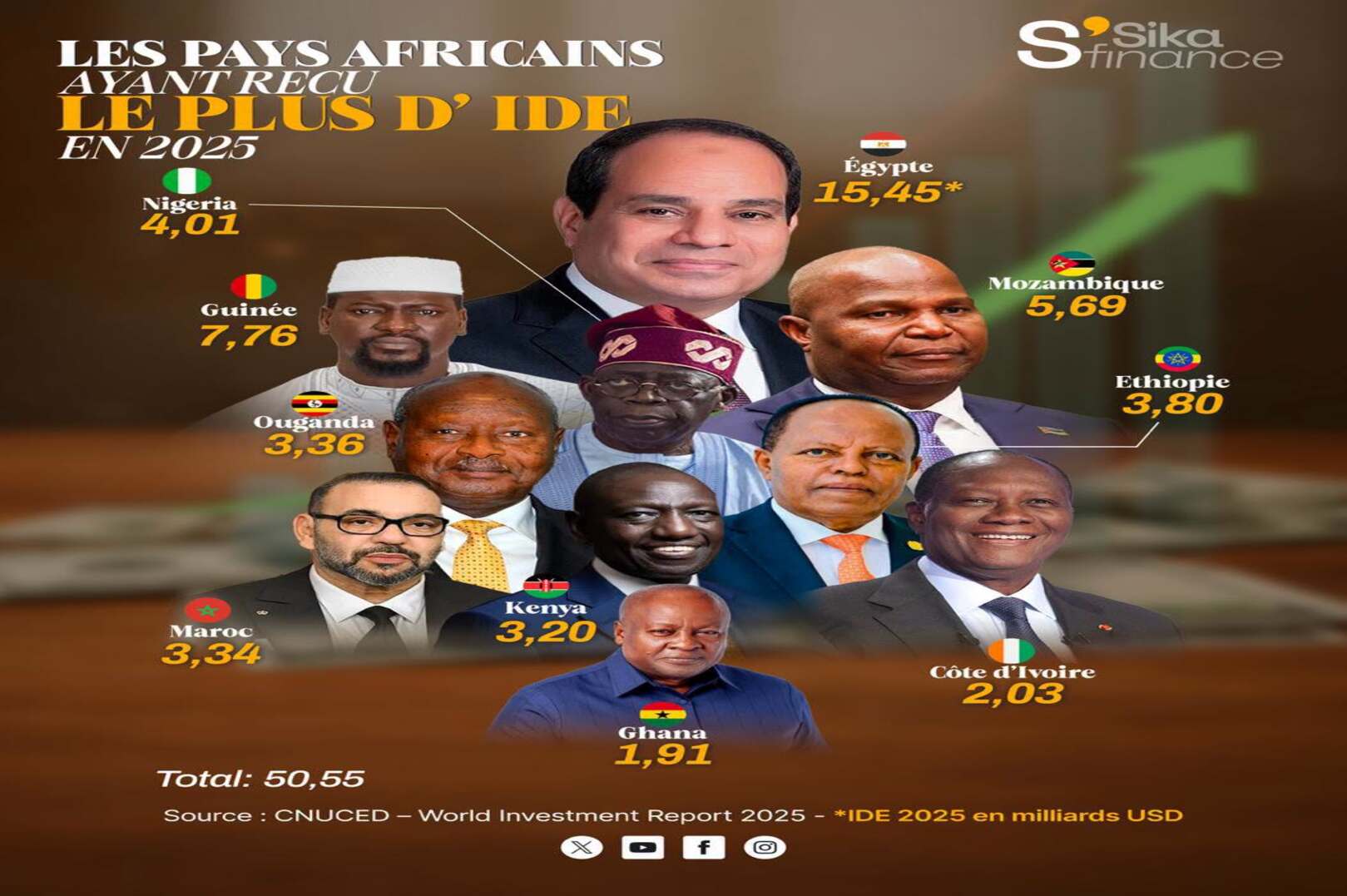
According to data from the United Nations Conference on Trade and Development (UNCTAD), Egypt ranked as Africa’s leading destination for foreign direct investment in 2025, attracting $15.45 billion in inflows. Guinea followed with $7.76 billion, driven largely by mining investments, while Mozambique secured $5.69 billion, supported by major energy and gas projects.
Nigeria, Africa’s largest economy, received $4.01 billion in foreign investment, followed by Ethiopia with $3.80 billion. Uganda ($3.36 billion), Morocco ($3.34 billion), Kenya ($3.20 billion), Côte d’Ivoire ($2.03 billion) and Ghana ($1.91 billion) completed the list of the continent’s top investment destinations.
Together, these ten countries attracted more than $50 billion in foreign direct investment, highlighting Africa’s growing role in global investment strategies despite ongoing economic challenges.
The distribution of FDI reflects the diversity of Africa’s growth opportunities. Guinea and Mozambique continue to benefit from strong investor interest in strategic natural resources, including bauxite, minerals and natural gas. Meanwhile, Nigeria, Morocco and Kenya are attracting capital through energy projects, industrial development, technology and infrastructure expansion.
Côte d’Ivoire’s position among Africa’s leading FDI recipients illustrates the country’s growing appeal beyond traditional commodities. Supported by economic reforms, infrastructure development and diversification efforts, the West African nation is increasingly attracting investors in sectors such as manufacturing, energy, logistics, agriculture and digital services.
For analysts, the new geography of foreign investment shows that global investors are increasingly looking for markets combining strategic resources, economic stability, industrial potential and large-scale development projects.
As African economies seek to create jobs, strengthen local industries and reduce dependence on raw commodity exports, attracting long-term foreign investment remains a key priority across the continent.