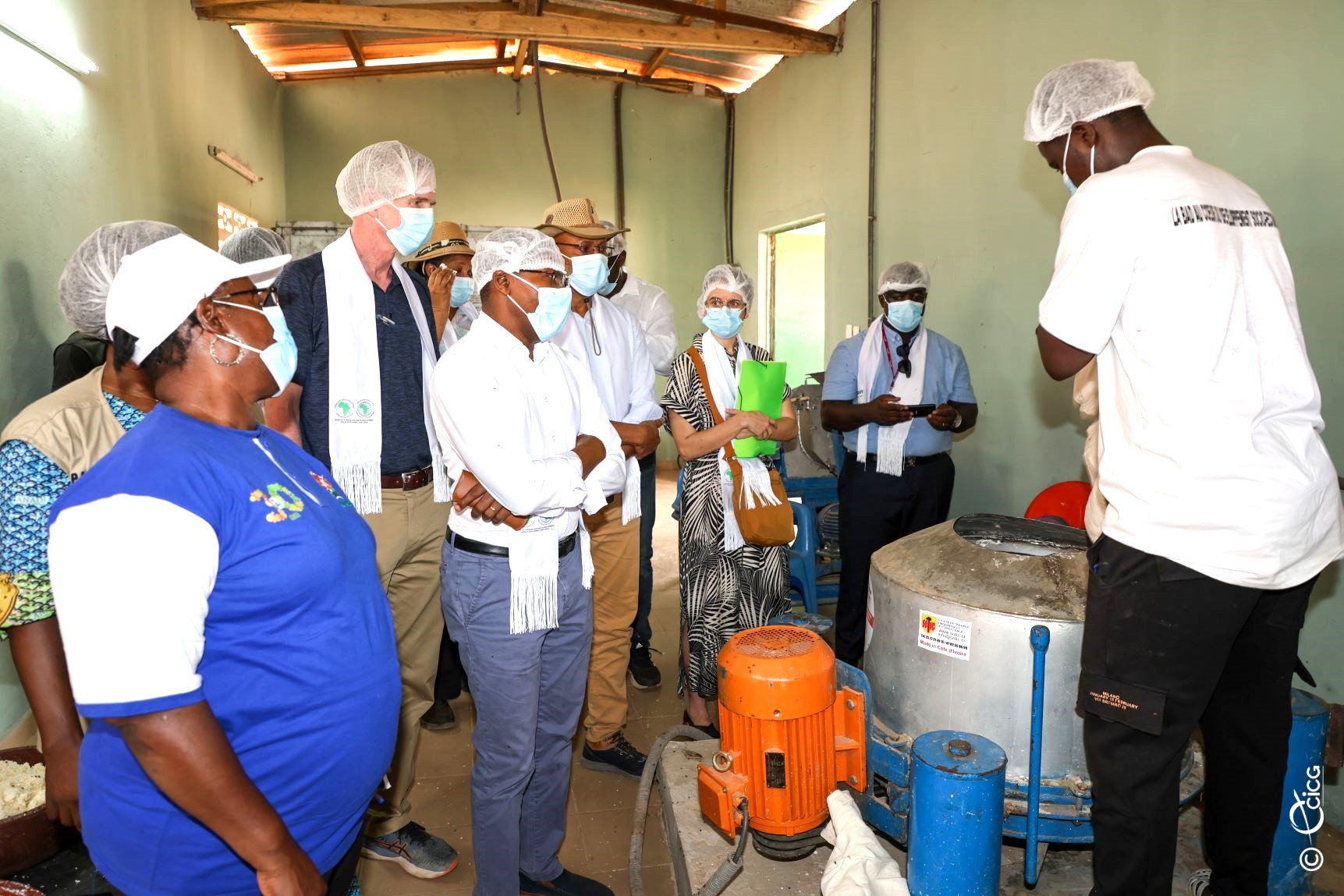
Semi-Industrial Cassava Processing Unit in N'Douci: The AfDB Hails a Tool for Promotion and Social Inclusion of Women
On February 7, 2025, the General Coordinator of the PSGOUV and PA-PSGOUV, Non Karna Coulibaly, visited the facilities of the semi-industrial cassava processing unit into attiéké of the Sanata group in N'Douci, accompanied by a delegation from the African Development Bank (AfDB).
The representative of Canada on the Board of Directors of the AfDB, which funds the Support Project for the Government’s Social Program (PA-PSGOUV), praised the dynamism of the women at this semi-industrial unit located in N'Douci. "The AfDB is proud to partner with such an initiative and demonstrates its commitment to supporting the priorities of the Ivorian government, whose ambition is to enable populations to benefit from the dividends of growth," said Edmond Wega.
He highlighted that PSGOUV, a multisectoral initiative aimed at vulnerable populations, aligns with Canada’s international aid policy. According to him, this policy focuses on several areas, including economic and social development, as well as strengthening the capacities of women and youth.
This visit, he added, aims to share experiences with the various actors involved in the project, with the goal of ensuring its sustainability and expanding it to other countries.
For his part, Drew Smith, Director General of Pan-African Affairs at Canada’s Ministry of Foreign Affairs, emphasized the importance of this project in promoting gender equality. He also noted that this is an integrated project that helps fight poverty. As a result, Canada, as a member of the AfDB's Board of Directors, will intensify its support for the effective implementation of the project.
Thanks to PA-PSGOUV, more than thirty women employed in this unit have managed to rise out of poverty. The production of attiéké, which was 350 kg per day, has now exceeded two tons.