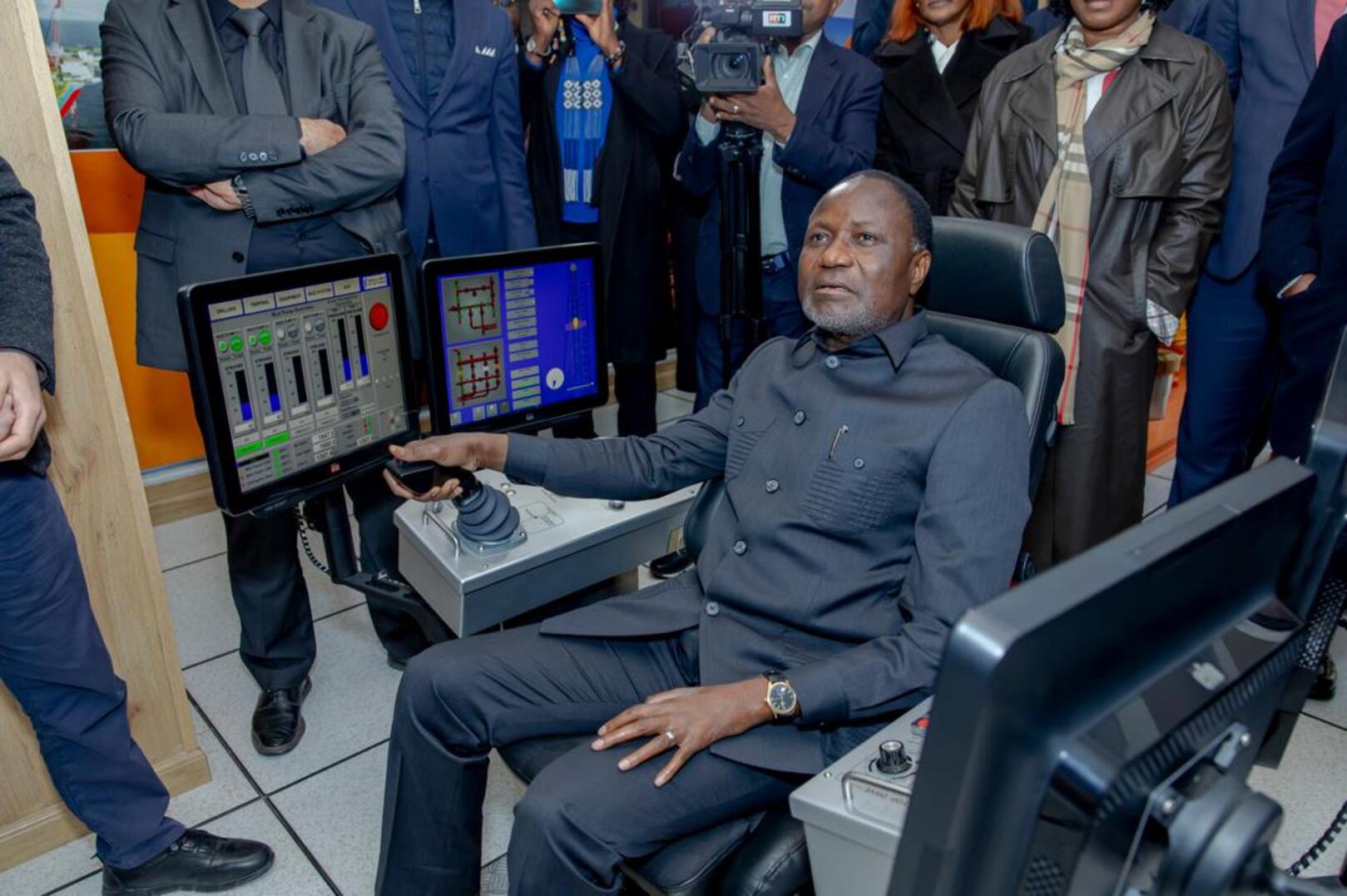
Visit to the Algerian Institute of Petroleum (IAP): Sangafowa-Coulibaly Draws Lessons from Algeria’s Energy Sovereignty
Following the signing of a strategic cooperation agreement with Algiers, the Ivorian Minister of Mines, Petroleum, and Energy, Mamadou Sangafowa-Coulibaly, made a highly symbolic visit to Boumerdès, an hour from the Algerian capital, to the Algerian Institute of Petroleum (IAP). For six decades, this institute has trained the human capital that enabled Algeria to build an integrated and sovereign energy industry.
During this third stage of his visit, the minister sought to understand the foundations of an institution whose reputation extends across Africa and beyond.
This visit comes at a pivotal moment for Côte d’Ivoire, as its oil and gas resources are expected to grow significantly. According to Minister Sangafowa-Coulibaly, the equation is simple: sustainable transformation requires local expertise.
“This is a vision strongly supported by President Alassane Ouattara, who emphasizes the critical need to develop an integrated extractive sector that generates local wealth beyond mere extraction. Côte d’Ivoire must succeed in this endeavor,” the minister stated.
In Boumerdès, the message was clear. “By the end of this visit, one better understands how Algeria achieved such encouraging results and maintained a high level of excellence,” Sangafowa-Coulibaly noted, highlighting the pride of seeing African institutions deliver world-class expertise that impacts an entire economy.
For Abidjan, the challenge is to accelerate. The country wants to avoid the common trap of extractive economies: producing without mastering the industry. Anticipating a surge in demand for engineers, technicians, and experts is essential as national production is expected to quadruple in the next three years.
Founded in 1965, two years after Sonatrach, the IAP is not just a training institute. It is a cornerstone of Algeria’s energy sovereignty, designed from the outset to support a national strategy. It produced the skilled workforce that facilitated the 1971 nationalization of energy assets.
Today, the institute functions as an industrial “skill factory,” supporting Sonatrach’s 149 subsidiaries and more than 66,000 employees. With four campuses, 30 laboratories, advanced simulators, and programs tailored to operational needs, it covers the entire oil and gas value chain: upstream, downstream, equipment manufacturing, petrochemicals, and even the export of refined gas products. In 2024, exports generated $42 billion in revenue (about 24,000 billion FCFA).
The institute’s pedagogical model is notable: a close link between academia and industry. “75% of our instructors are Sonatrach experts, including retirees. This allows us to leverage decades of experience,” explained Director Dr. Mohamed Khodja.
The result: a critical mass of engineers, technicians, and staff able to fill every position in the sector. “All positions at Sonatrach are now held by Algerians,” he emphasized, highlighting the strategic purpose of the model.
Abidjan is refining its own strategy. The Ivorian minister envisions replicating an integrated model linking a national company and a training institute. Côte d’Ivoire is already collaborating with IAP, and this visit reinforces the desire to expand the partnership.
The idea of a “corporate university” linked to Petroci, similar to the Sonatrach-IAP connection, could take shape.
Executives from Petroci and the Ivorian Refining Company (SIR), Fatou Sanogo and Tiotioho Soro, have expressed their intention to leverage IAP’s expertise to strengthen internal capacity-building programs at all levels in anticipation of their sector’s growth.
While Algeria stands out for training and industrial integration, the partnership is not one-sided. Côte d’Ivoire brings recognized expertise in offshore operations, a field Algeria seeks to develop, while SIR’s hydrocracker-equipped refinery has attracted Algerian interest for potential investments. These bridges suggest a more balanced and mutually beneficial cooperation than initially apparent.